Tuesday, 2nd June 2026
In ATC today….
Royal Ascot is still a fortnight in advance of us….
…. but it’s never too soon to get a handle on the preparation….
…. today we’ll have an early looksee at an angle into the Wokingham….
Oh…. and we won’t get a chance later in the week with Epsom dominating the focus….
Read on….
-----
Unique features produce unique race circumstances….
…. and it’s always interesting to assess what impact or effect those unique race circumstances might have on outcomes....
The Wokingham is unique in that it’s the one big race run up the straight 6f at Ascot that habitually attracts 25+ runners....
…. 21 of the last 24 renewals saw between 25 and 29 runners emerge from the stalls – and a field of up to 29 runners stretches a long way across the Ascot track….
At the start of the race – when the horses are in the stalls – more of the track is potentially in play than is the case for any other race up the 6f strip....
If there’s a part of the track which is quicker and more advantageous than other parts….
…. owing to drainage, compaction, conditions or whatever….
…. then the Wokingham is a race that should advertise that fact over time....
-----
Of course, the stall in which a horse starts a race is not the be-all and end-all....
Pace – and where that is on the track – plays a big part. So too the tactics required by individual horses. It also matters which horses and jockeys are drawn in which clusters....
And nothing is more important than ability. Put five animals with just three legs apiece in the middle-5 stalls and it won’t make any difference how advantaged or disadvantaged those middle stalls are – physical limitations will see to it that those horses don’t win....
On top of that, track biases come and go. Conditions one week can alter biases which might otherwise have held steady for ten years....
Looking at the performance of individual stalls in the last 14 editions of the Wokingham (as we are about to do) won’t tell us much about conditions on the track at this year’s Royal meeting….
…. other races run at the meeting before the Wokingham will provide more pertinent real-time guidance....
But how stalls performed in previous editions of the unique Wokingham will tell us something worth knowing. It’s a part of the information record worth consulting....
-----
The table below shows the performance of each individual stall (in terms of % of opponents beaten) in each of the last 14 renewals of the Wokingham....
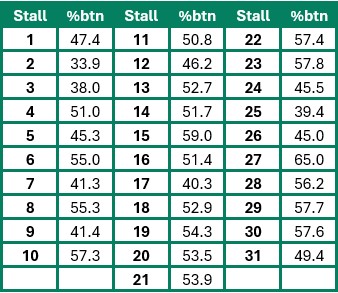
Now, I understand if your initial reaction to that table involves scratching your head....
Let me make it a little clearer by grouping the stalls into thirds – bottom third, middle third, and top third....
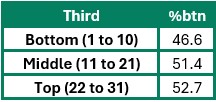
Now, we see something a bit more useful....
The bias is not heavily pronounced. But it’s there….
Horses drawn in the middle beat a bigger proportion of their opponents than the horses drawn low….
Horses drawn high beat a bigger percentage of their opponents than horses drawn in the low and middle third stalls….
In addition, I would say this: 8 of the top 10 performing stalls are numbered 10 or higher. 7 are numbered 15 or higher….
…. and 5 of the bottom ten performing stalls are single-digit stalls….
These observations alone won’t lead directly to the winner, of course. But they help us take an informed view. They give us context to work with….
The individual runners, pace, tactics and all the rest of it will need to be considered – for sure….
…. but there’s no getting away from the fact that ‘live’ contenders drawn high are better off than those drawn low....
That’s something worth knowing….
…. I can guarantee that plenty of people you bet against at when Royal Ascot gets underway won’t be aware of it....
-----
That’s all for today….
Back tomorrow….
Meantime – contact me at – nick.pullen@spapublishinggroup.co.uk
Stay tuned….
 Operated by Spa Publishing Group Ltd (Company No. 15830286)
