Thursday, 13th August 2020
The Ebor meeting gets underway at York on Wednesday….
This column will be at the meeting for all four days and – among other things – I will be bringing you my idea of the value in the big-field handicap races....
The highlight of the meeting for handicap punters is undoubtedly the Ebor – run on the Saturday of the meeting….
Yesterday, I was talking about how the long-term stats for that race cannot be entirely relied upon as field splitters.
Changes to the prize fund have significantly altered the basic structure of the race. Prize money is down this year, but I don’t expect the race to return to what it once was. I still expect a classy field….
Today, I want to backtrack ever-so-slightly and highlight one aspect of the historic record that might still prove reliable going forward….
One thing hasn’t changed about the Ebor. The race will still be run around the flat 1m6f strip at York – comprising three left-handed bends....
Whenever there’s a big-field race run around one or more bends we must be open to the possibility that the horses drawn widest are at a disadvantage to the horses drawn lowest....
It makes sense, doesn’t it?
The horses drawn out wide will likely be covering more ground than those drawn inside. And that cannot be advantageous....
Either that or the riders on those wide-drawn horses will need to sacrifice valuable energy early doors in order to secure better racing position on the track – a manoeuvre that might cost them dear at the business end of the race when every ounce of reserve energy might count....
The case for a low draw over a high draw makes theoretical sense. But sense and practice rarely come together where horse racing is concerned....
That is one of the sport’s many charms – and a feature of the game that encourages people like me to persist with the delusion that we might one day become clever enough to finally crack the code once and for all....
What makes sense theoretically does not meet with what generally happens in practice in the Ebor at York – please note that the 2008 renewal was run at Newbury....
Fourteen of the last 17 Ebor winners at York ran from a double-figure stall. The details appear below….
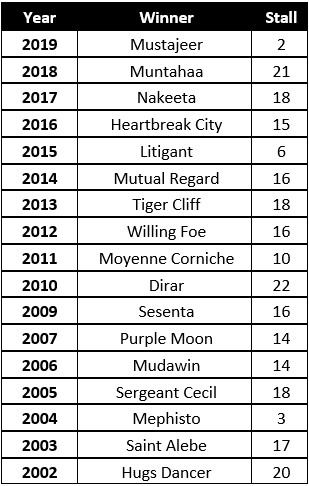
A sample of 17 hardly amounts to scientific rigour. Any fool knows that....
And what has happened in the last 17 editions at York might well prove to be a statistical aberration over the course of the next millennium....
But I don’t have the luxury of waiting that long to find out. I must take a view on this issue now....
And, right now, I cannot accept that so many horses overcame what on paper appears to be a disadvantage as a result of luck or happenstance....
The distribution of placed horses supports this view too....
25 of the 50 placed horses in those 17 Ebor renewals at York were drawn in a single-figure stall....
Yes, the figures for the placed-horse conform a little more closely to theoretical expectation – that low drawn horses should do well....
But the low stalls still only managed to produce only 50% of the placers over the period....
Perhaps the conclusion we should draw – however tentative – is that being drawn low in the Ebor at York is not the advantage it appears to be on paper. It is not the plus-point that sense or theory suggest it might be....
Indeed, it might instead be something of an impediment or a handicap....
I don’t want to get all theoretical on you. My race-riding experience amounts to the thin end of nothing whittled to a fine point....
But maybe horses drawn low in this big-field long-distance event get swept along a little too quickly early-on – and are positioned to have no say in the matter....
Whilst those drawn wider are free to drop in behind, take things more sedately early-doors and conserve energy for the big push late on....
I don’t know. But that’s how it seems to me....
My primary point is this: I don’t think changes to prize money or the ratings of the horses contesting the race on Saturday will make much difference to this track-specific feature of the race....
However rich the contest, however grand the horses and connections, and as counter intuitive as it might seem, being out wide might well remain the right place to be at the start....
York isn’t the only game in Yorkshire for handicap punters over the next week or so….
Up at Ripon on Sunday we get the 2020 edition of the Great St Wilfrid – a C2 run over the North Yorkshire track’s straight and undulating 6f strip....
This has been a fair race for contrarian punters like us to target in recent times. There’s been just six winning favourites in the race since 1990. And ten of the last 18 favourites finished the race unplaced....
The market is frequently bamboozled in this one. And that’s the way we like it. Horses with the talent to get competitive can often be backed at value prices....
The first thing to say is that winning a Great St Wilfrid off a 3-figure mark is no easy task....
Two horses rated 100-dead have managed such a win over the last 18 years....
But whilst other horses rated higher have managed to go well in the race, none managed to beat all the other participants home....
The lower-rated horses have dropped from the radar too as the quality – and prize money – of the race has improved. No horse rated in the 80s has managed to win since way back in 2005. Few even make the cut for the race these days....
The percentage play is to focus on horses officially rated 94 to 100 – a group that has won 15 of the Great St Wilfrid renewals since 2002....
Not too many 3yos go to post for this one. But those that did have not done bad – producing a win and two places from thirteen participants in total....
As with most sprints, winners come from left, right and centre – age is not a bar. We’ve had 6- and 7-year-old winners this century – along with plenty of additional placers....
But my preference would always be with the horses aged 4- and 5-years-old. That group is responsible for 12 of the last 18 race winners. Also, for 31 of the last 53 placed finishes in the race....
The numbers make some sense. The younger horses are just that – less shop-worn than their older counterparts and with stronger claims on natural progression at this point in their respective career paths....
The 4yos especially are prone to being better-handicapped than some of the opposition – having matured from 3 to 4 and maybe not having shown an entire hand yet during this season to the official handicapper....
That’s all from me for today. I’ll be back tomorrow with more....
Until then. Stay tuned.
 Operated by Spa Publishing Group Ltd (Company No. 15830286)
