Tuesday, 2nd March 2021
This morning, we take the opportunity to continue with our spadework ahead of the 2021 Cheltenham Festival....
One thing I always try to do is to look at information or a dataset from a perspective that probably differs from the one the market (or the largest share of it) is using....
Nothing too clever or onerous – just a tweak on the dial that produces a slightly different set of observations and insights....
Going about things a bit differently is part of my contrarian approach here at ATC....
The exercise can prove useful and productive in betting terms – providing pointers and avenues of exploration that are not immediately visible to the punters you’ll be betting against....
I’ve made the following point repeatedly in the past....
A horse can run the race of its life in a handicap at the Cheltenham Festival and still not win or even place....
Yet winning and placing are the basis on which most stats you’ll read about are produced....
I do it myself – using wins and places as the basis for many observations and insights I make....
But at the Festival – and especially with the handicaps – it is worthwhile tweaking the dial and focusing on competitivity rather than just wins and places....
At the Festival, failing to win or place is not the same thing as producing a bad run or an under-par performance....
At the Festival, a ‘competitive’ run can represent a hell of a performance – and it is worth worthwhile knowing which yards produce most of them and with what frequency....
By ‘competitive run’ I mean horses that finished within 0.5 lengths per furlong of the winner....
So, in a 2-mile handicap race I’m looking for horses that finished within 8-lengths (16-furlongs x 0.5) of the winner....
In a 3-mile handicap race I’m looking for horses that finished within 12-lengths (24-furlongs x 0.5) of the winner....
This is just my own rule of thumb. There’s nothing scientific going on here....
This is not some kind of official measurement or standard practice. It’s just how I choose to do it....
You could find your own way. You could produce a variation on the general theme. My rule is not a hard and fast rule. It is just my rule. No more. No less....
For the purposes of my own analysis, a horse that has run a competitive race in a handicap at the Cheltenham Festival is one that got to within 0.5 lengths per furlong of the winner – regardless of the actual placing....
Over the weekend, I subjected the handicaps (all of them – whatever the nature of the individual race) run at the Cheltenham Festival over the last 7-years (chases and hurdles taken together) to my competitivity test....
In the first instance, the test serves only to confirm something that we already know – that certain yards (the familiar ones with the best horses and the most resources) perform best and produce the lion’s share of competitive runners in Festival handicaps....
But what is interesting is to compare the performances of those individual yards....
The table below highlights the performance of those individual yards (the big guns) over the test-period....
It shows wins, other competitive runs (in or outside the frame), total number of competitive runs, total runners and competitivity expressed as a strike-rate percentage....
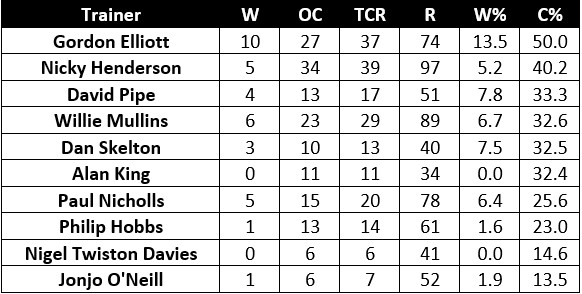
Paul Nicholls sits further down the rankings than you’d expect – with figures probably short of what you’d anticipate….
Week to week throughout the season Nicholls is a man who can be relied upon to be hitting winners somewhere close to 20% of the time – and with plenty of other runners getting competitive. Whereas at Cheltenham, he’s not been the go-to man….
Perhaps the two observations are connected. Maybe Nicholls doesn’t target Cheltenham in the same way some of the other big guns clearly do….
Maybe he is profligate with his ammunition year-round – targeting big pots all over the place rather than keeping his powder dry for a single highly-competitive 4-day meeting….
Jonjo O’Neill has a reputation of being a big gun at the Cheltenham Festival. His wider record across the years probably merits that standing….
But his recent record in the handicaps doesn’t add much shine to the apple. He hasn’t been as strong a force at the meeting as perhaps he once was….
Nigel Twiston-Davies is another handler considered a bit of a Cheltenham specialist. He certainly likes a winner at the track. But his string hasn’t been pulling up trees in recent Festivals.
Compared to the other yards, Twiston-Davies has been well off the pace – like O’Neill….
The data in the table is clear. If you were going to nail your colours to the mast of one man in this season’s Festival handicaps, Gordon Elliott would have been your best bet....
The trouble is this year that we can’t say for sure he’ll even be there. And if he is, we can’t know what effect the events of the last few days will have on his mindset, the dynamic within his team or the performance of his horses out on the track….
Until we know he’s not going, I’ll assume Elliott and his team will be I attendance at Cheltenham as per normal….
If that’s the case then nothing changes the fact that Elliott has been the most reliable and consistent trainer when it comes to sending out handicappers sufficiently well-weighted, sufficiently capable, and sufficiently primed to produce big performances in some of the most competitive and hotly-contested races you’re ever going to see....
That takes skill, know-how and to-the-moment planning and preparation. To do it so consistently that his horses are competitive 50% of the time – over a 7-year period – discounts any notion of luck or fluke....
There is method at work. Method that produces consistently high-end results. And there’s no reason to believe Elliott won’t be following and applying the same method this time round – should he and his horses be in attendance….
Of course, the stats have their limitations. They only tell us what happened before. They are not a certain guide as to what will happen in the future....
But Elliott’s record of competitivity is something worth being aware of. At the very least it alerts us to the fact that any handicapper he sends out at the Festival is worthy of closer and deeper scrutiny – especially when it can be backed at a price….
Of course, if Elliott is banned ahead of the Festival or horses are moved from his yard – both distinct possibilities this morning – that will change the landscape in the handicaps (as well as across the wider meeting)….
Nobody entered more horses in the Festival handicaps this year than Elliott. And plenty of his horses would be fancied to run big. If he – or they – are a no-show that situation will create opportunities for other yards….
The top players – the proper big guns – are obvious. They appears in the table above. You can expect those yards – at least those towards the top end of the table – to produce competitive handicap runners again this time around….
But other yards – not such big guns – are in with a shout too. A few smaller – or more off-the-radar – yards have been quietly building promising numbers when it comes to competitivity in the handicaps at the last few Festivals….
We’ll take a look at some of those yards tomorrow. They could be big beneficiaries if Elliott and his team are ruled out….
That’s all from me for today. I’ll be back tomorrow. Meanwhile….
Anything to report? Anything to say? Anything to share? Contact me at: nick.pullen@oxonpress.co.uk
Until next time. Stay tuned.
 Operated by Spa Publishing Group Ltd (Company No. 15830286)
