Thursday, 18th December 2025
In ATC today….
I’m looking forward to the big handicap run over Christmas – the Welsh Grand National at Chepstow….
…. weight is a big factor and should play a part in your pre-race deliberations – so too age and experience….
…. but the track doesn’t always produce the kind of outcomes that the layout and topography suggest it should….
Oh…. and there’s a wider point to be made about racing in general on top of all this….
Read on….
-----
Chepstow in midwinter is a slog – especially when it turns heavy….
Ruby Walsh once said that while the Aintree Grand National was run over further….
…. the Welsh version felt longer….
…. and – over the stamina-sapping 3m6f trip – weight is a disadvantage….
The stats say 11-00 is a key cut-off point….
…. 19/25 winners carried no more than 10-10….
Only one top-weight won during that period….
…. Native River in 2016….
…. and he was no ordinary handicapper – winning a Gold Cup in 2018….
Synchronised also carried weight to victory in 2011….
…. 11-06 off a mark of 150….
He was no average victor either – winning his Gold Cup the following spring….
Notre Pere won off 152 in 2008 – carrying 11-00 because Halcon Genelardais ran off 164….
Elegant Escape carried 11-08 off 151 in 2018 and was thought a potential Gold Cup horse himself at the time….
Nassalam won carrying 11-03 in 2023 – suited better than everything in the race by conditions….
-----
This race is not easy to win off a long break….
The trip and an often gruelling surface create an environment where flaws in fitness are ruthlessly exposed….
24/25 winners had been off 3+ weeks. None had been off 8+ weeks….
You need experience at marathon trips. 24/27 winners had run at 27f+ over fences (17 registering a win)….
Don’t bank on too much experience either. Veterans don’t have a great record….
Exceptions are 13yo Raz De Maree (2017) with 13yo Alfie Spinner in second. Mountainous won (2015) aged 11. The Two Amigos won in 2022 aged 10….
…. 22/25 winners were aged 6 to 9 – 17/21 were no older than 8….
…. 24/28 winners had raced no more than 17 times over fences….
…. 20/28 had won no more than two handicap chase events….
-----
A lot of data points to front-running horses being favoured over fences….
…. and that bias should be particularly exaggerated at Chepstow….
There are three reasons why I reckon that’s the case….
One – a couple of downhill sections in the finishing straight make it less likely that horses up front will tire and come back to the field – at least less likely than is the case at a more conventional track….
Similarly – those downhill sections make it harder for horses playing catch-up to make up ground on the leaders late on….
Two – Chepstow is the only jumps track in Great Britain which confronts horses with five fences after making the turn for home….
At every fence even the best jumpers travelling with the most momentum must slow down to negotiate the obstacle before pressing on again on the landing side….
Tracking data tells us that horses typically lose 10% to 15% of their speed on the approach to a fence – and more than 20% if or when they get it wrong….
This stop-start requirement is particularly pronounced late in proceedings at Chepstow – and should make late gains of ground difficult for horses in arrears at that point….
Three – soft ground. It’s harder to make up ground late on when the ground is slow than when the ground is quicker – on pretty much any chase track….
When the ground is slow and deep at Chepstow you can rely on it being slower and deeper than at any other track in the country – and, consequently, it should be harder to make late gains….
Obviously, the ground isn’t always slow and deep at Chepstow. But it generally is pretty slow and deep – at best – at this time of year….
-----
All this being the case….
…. it’s reasonable to expect the front-running bias to be reflected in the results of the premier chase handicap run at Chepstow – the Welsh Grand National….
The table below tells us where each of the last 18 winners of the race were positioned early doors – as determined by formbook comments….
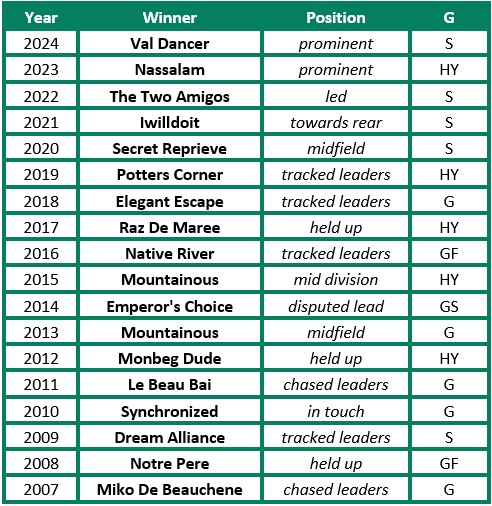
…. and it’s not quite what I expected….
A fair proportion of the winners were positioned in midfield or even further back in the early stages….
The fact is that despite the downhill sections of the track – which should help front runners stay in front….
…. and despite the number of fences in the home straight – which should make it hard for horses in rear to make up late ground….
…. and despite the race frequently being run on ground that is described by Raceform as soft or worse….
…. the winner of the Welsh Grand National hasn’t been a front runner on 7 of the last 18 occasions….
And it’s not even been a case of winners making up ground only when the ground is decent….
Winners have come from backward early positions – even on desperate ground….
You don’t have to travel up front to win a Welsh Grand National. That’s the bottom line….
-----
So much for my theories…. so much for angles…. and so much for expectations developed (reasonable or otherwise)….
It doesn’t matter how much thinking you do…. how many clever observations you make…. or how many smart angles you construct….
…. racing isn’t necessarily going to conform….
Outcomes will frequently confound and perplex because racing – at its heart – is ultra-unpredictable, based on myriad variables, and ultimately unknowable….
That is its charm….
…. and its curse….
I suppose that’s the wider point I’m making today….
In horse racing, no observation can be wholly relied upon….
…. no theory is bombproof….
…. no stat can be 100% trusted….
No fact – however long it has endured – is immune to imminent destruction….
Indeed, that moment you start to believe you know something about racing is the most dangerous of moments….
At that point you can be certain of one thing only: you’ve just stepped out onto thin ice that can’t possibly bear your weight….
-----
That’s all for today….
Back tomorrow….
Meantime – contact me at – nick.pullen@spapublishinggroup.co.uk
Stay tuned….

 Operated by Spa Publishing Group Ltd (Company No. 15830286)

